Cutting Torch Safety - Section 1. Understanding the fundamentals of combustion
Cutting torch safety Q&A
1. What are the three basic elements in the triangle of combustion?
a. Fuel
b. Oxygen
c. Kindling temperature
All three elements must be present to support combustion. It is important to understand that virtually everything can be a fuel source. When burning a particular fuel, the combustion process will stop if the fuel drops below kindling temperature; the oxygen supply becomes depleted; or, the fuel is used up.
2. Does the oxygen in a oxy fuel cutting torch burn?
No.
Pure oxygen is nonflammable. Oxygen is a colorless, odorless and tasteless elemental gas that supports life and makes combustion possible. It constitutes about a fifth of the atmosphere – approximately 21%. All elements but the inert gases combine directly with oxygen, usually to form oxides. However, oxidation of different elements occurs over a wide range of temperatures with phosphorus and magnesium igniting spontaneously in air at ambient temperatures. All materials that are flammable in air burn much more vigorously in oxygen. Some combustibles, such as oil and grease, burn with nearly explosive violence in oxygen if ignited. Oxygen lowers the ignition point of flammables and greatly accelerates combustion.
Oxygen is shipped as a non-liquefied gas at pressure above 2000 psi, and also as a cryogenic gas at pressures below 200 psi. Industrial applications for oxygen include combination with acetylene, hydrogen and other fuel gases for such purposes as metal cutting, welding, hardening, scarfing, cleaning and dehydrating.
3. What is the value in knowing kindling temperatures of materials?
Combustion is expected to occur – which could be very rapid. Storage of oil and grease soaked rags is a classic example of this condition. Materials with a low kindling temperature, in the presence of oxygen and minimal heat, can ignite spontaneously. When certain fuels burn, whether liquid or gas, their respective rate of burn is so rapid that we refer to the burning process as an explosion.
4. What is the difference between burning rate, temperature output and BTU output?
Burning rate refers to the speed with which the combustion process will consume the fuel source. Temperature, obviously, is how hot the fire actually is, but BTU refers to the energy that the fire will produce.
Fuel sources vary in their characteristics of burning rate, temperature and BTU output. When fuel gases are used, as in cutting, welding and heating processes, these differences are very important.
A simple demonstration to show the effect of oxygen in the combustion process is to light a small candle. After the candle burns for a short time, place a glass over the candle, allowing no oxygen to enter the system. After a few seconds, the flame goes out. This simple example shows that by altering one of the basic elements of combustion, the process of combustion stops.
If you were to add oxygen from a cutting torch to the candle flame, the candle would burn furiously. A cutting torch is sometimes also called an oxy fuel torch. oxy fuel is a generic term that encompasses all fuel gases like propane, propylene, acetylene, natural gas, mapp gas, or any other fuel gas.
Learning about fire triangles can be pretty boring but using a cutting torch safely requires a good understanding of combustion.
A cutting torch is one of the most useful tools ever... Unfortunately, it seems like sometimes, the more useful a tool is, the more dangerous it is. A cutting torch, used improperly, is also is one of the most dangerous tools ever.
Now you are ready for Section 2 ...see Oxy fuel topics below
• MAIN PAGE ON CUTTING TORCH OXY FUEL SAFETY
• SECTION 1. Understanding the fundamentals of combustion
• SECTION 2. Proper handling of compressed gas cylinders.
• SECTION 3. Oxy-Fuel gas characteristics
• SECTION 4. The burning process
• SECTION 5. Proper operation of oxy-fuel heating tips
• SECTION 6. Oxy-fuel Equipment inspection
• SECTION 7. Oxy fuel Safety torch - tips
leave cutting torch safety info and go to main cutting torch safety page


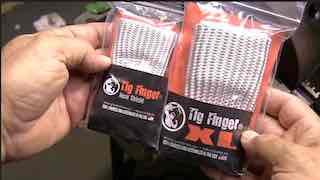
The Real and Original TIG Finger® and XL model
 Subscribe To This Site

