Cutting Torch oxy fuel safety - Section 5. Setup and Use of Rosebud Heating Tips

cutting torch tips are much easier to deal with than some other oxy fuel oxygen acetylene torch tips.
1. Of all gas operated equipment, which causes the most difficulty for the operator?
Multi-Flame (Rosebud) heating tips.
2. What are the causes for oxy fuel multi-flame (rosebud) heating tip problems or failures like overheating, flashbacks, popping etc.?
Tip starvation of insufficient gas flow is the usual reason.
A rosebud is designed to use a lot of oxygen and acetylene gas flow. A cutting torch tip uses a lot of oxygen sometimes but a rosebud needs a lot of both gases flowing to keep it cool and to keep from popping back.
Another cause is operation in a confined space. (like poking the rosebud up inside an intake manifold ) In this situation, reflected heat is not able to escape, and it raises the temperature of the tip.
If the velocity of gas flow outward through the tip is slower than the rate of burn of the gas, the flame will attempt to burn inside the tip. As the tip heats, more inner tip ignition of gases will occur. This will produce a banging or popping sound, and can lead to a flashback. A flashback is defined as the burning of mixed gases inside the tip and/or torch, backward, to the point where the gases mix. Various torch manufacturers design for the placement of the mixer in different locations in the torch. In ‘modern’ torches, the mixer will be located in one of three locations – the tubes; the head; or, the tip. Mixers can be fuel gas specific or universal.
A gas mixer, is that part of the torch that allows the combining of oxygen and a fuel gas. Oxygen and fuel gas are flowing separately within the torch until this point. A mixer that is fuel gas specific has openings, or a number of orifices, designed for the size of the gas molecule of the specific fuel gas, to flow into the mixer and on through the tip. Each fuel gas molecule is of a specific size. (For commonly used fuel gases, acetylene has the smallest mixer orifice.) It is designed to provide for the unique oxygen/fuel gas mixing ratio, for the particular fuel gas being used. A universal mixer has large enough openings to allow any fuel gas to pass through. A universal mixer has advantages, but is not the best mixer for any one fuel gas.
3. What is the withdrawal rate of an acetylene cylinder?
1/7 of the cylinder contents per hour.
each manufacturer has a tip chart that lists how much gas a particular rosebud tip uses per hour. Multiply that number by 7 and that is the minimum size tank you need to use.
Acetylene gas vaporizes out of the acetone suspension. The withdrawal rate has a maximum threshold of 1/7 of the contents per hour. Exceeding this rate will cause acetone to be withdrawn from the cylinder. Each heating tip requires a certain consumption of gas. The consumption chart needs to be used to calculate for sufficient fuel gas supply. For example, if using an ST 610 heating tip, the fuel gas consumption is 136 cubic feet per hour. If using one 330 cubic foot acetylene cylinder, only 47 cubic feet of gas is available per hour. It will require manifolding of three cylinders in this case, to provide sufficient fuel to correctly operate this heating tip.
Most people completely ignore this. You just cant run a big rosebud with a little biddy acetylene tank.
Big Tip,,,,Big Tank!
4. What is the correct process for setting flow when using a heating tip?
Maximum flow or ‘wide open’. thats right! wide ass open..
It uses a lot of gas , but it is the safe way to use a rosebud.
A common mistake in setting gas flow when using heating tips, is to starve the tip. The flame dimension may appear to be maximized, when less than maximum flow is passing through the tip. With the regulator pressures set at the recommended level, proper flow is to open the fuel valve to maximum flow, then neutralize with oxygen addition.
Ready for Section 6? see below
• MAIN PAGE ON CUTTING TORCH OXY FUEL SAFETY
• SECTION 1. Understanding the fundamentals of combustion
• SECTION 2. Proper handling of compressed gas cylinders.
• SECTION 3. Oxy-Fuel gas characteristics
• SECTION 4. The burning process
• SECTION 5. Proper operation of oxy-fuel heating tips
• SECTION 6. Oxy-fuel Equipment inspection
• SECTION 7. Oxy fuel Safety torch - tips
Would you like to get free welding videos in your inbox every week?

Tig FingersThe Real and Original TIG Finger® and XL model
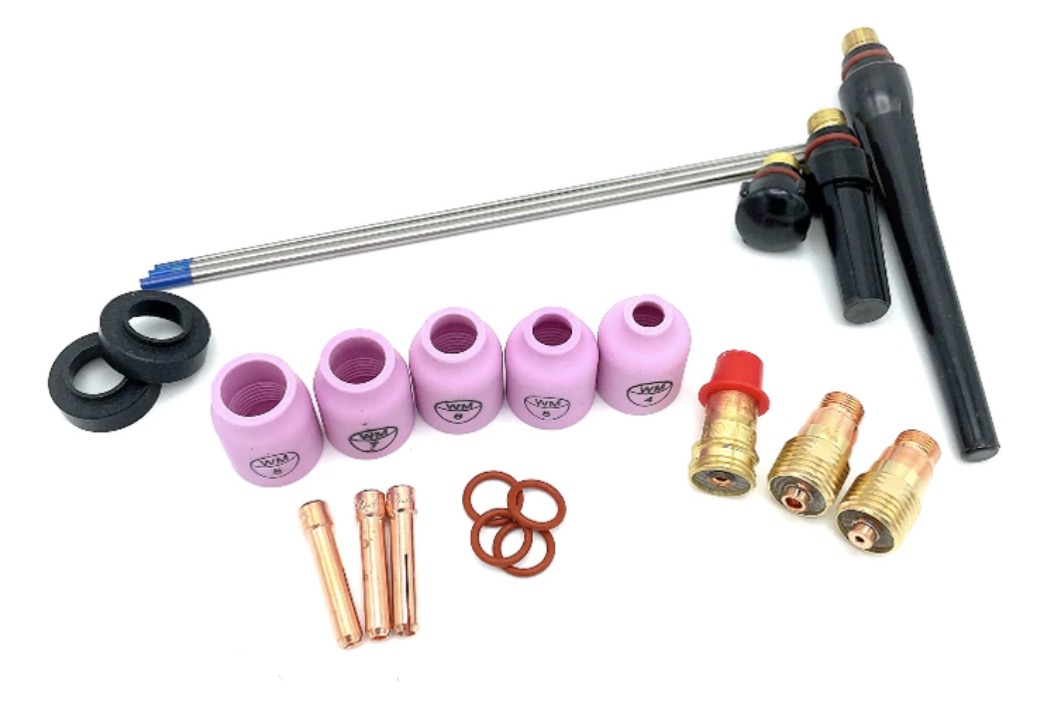
Stubby Gas Lens and Pro TIG kits
2% Lanthanated, CK LaYZr, Purple, more
Our Weldmonger Stubby Gas Lens kit is the Best

 Subscribe To This Site

