A Mig Welding Technique From an Old Timer

Here is a mig welding technique I picked up from an old timer in South Carolina over 20 years ago and I have been using it ever since.
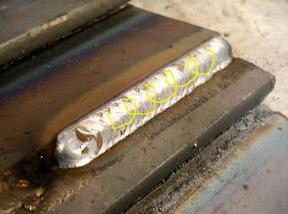
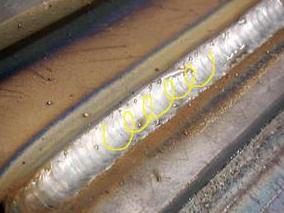
It is simply a series of u’s or cursive E’s depending on how thick a weld deposit you want to put down.
Overlapping back into the puddle further increases the weld deposit and not overlapping at all increases the travel speed and keeps the arc on the front of the puddle.
It just depends on the job being done as to which is better. A caution… if you overlap too far and make large ovals or circles, you run the risk of staying too far back in the puddle and welding on your weld instead of penetrating into the base metal.
Just watch the front edge/leading edge of the puddle and make sure it is biting in and make sure your arc traces the front of the puddle.
This works for all kinds of welds: flat, horizontal, overhead, downhill etc. its just a really good mig welding technique that gives you a good ripple pattern because its very methodical and intentional.
If you have ever seen someone weld randomly just moving the arc like it was an oxy acetylene torch with a brazing rod, you know the end result is usually a weld that looks like fido’s butt.
In your minds eye, you need to be trying to replicate some kind of intentional motion that gives uniformity and evenly spaced ripples. That’s what a machine does and if you want your welds to look like a machine did them, that’s what you need to do as well.
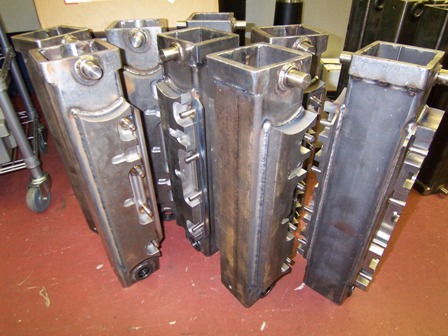
Several times a year I take on a project where I weld about 20 parts that are essentially a piece of 4” square tubing with ¼”wall thickness to 2 pieces of 1 inch thick steel machined plates.
Each part has over 80 inches of weld.
I get paid by the job on this project , not by the hour so I am always looking for good mig welding techniques that save time and still look good and are sound welds.
What I have found is that by not overlapping loop on this mig welding technique, it speeds up travel speed by about 30 to 50 percent. The welds I am doing on these projects need to look good , not have any pores that would leech out at the plating shop, and need to be sound welds but not very big because the heavy plates being welded are added just for weight.
So what I do is set the mig machine which is a plain old millermatic 250 to around 21 volts and about 280 inches per minute of wire speed using er70s6 .035” wire and I hold s short stickout and weld a series of U’s or I guess you could actually describe the welding technique as a series of ocean waves, and I travel just about as fast as I can. I probably make about 2 motions per second.
Sometimes I even time myself on a part to see how long it takes to weld both 1 inch plates on each side of the square tubing.
Pushing vs pulling mig welding techniques
Are you kidding me? Are we still talking about this? Both work. Both are good,
you need to be able to push and you need to be able to pull.
Here is an exception though… Spray arc, or spray transfer.
If your mig welding machine is setup for high amperage production work, you are probably using spray transfer.
Even though spray transfer is a different animal than short arc or short circuit transfer , it is still referred to as mig welding. For spray transfer, pushing the puddle is usually the way to go.
That’s probably where the whole argument about pushing vs pulling got started in the first place.
A word about spray transfer mig welding techniques.
• You need a mig welding machine that is beefy enough to handle it. That means a high duty cycle or else your machine will overheat or even crap out on you.
• You need to use at least .035 “ wire and .045 is probably much better
• You need a different gas…75/25 argon/co2 works fine for regular short circuit mig, but for spray , 90/10 argon/co2 or even higher percentages of argon mix are needed.
• You will hear a few welding gurus claiming all kinds of things that supposedly can’t be done.
Be skeptical but keep an open mind….because sometimes people are just full of crap.
more mig welding techniques lincoln mig welding school ...a review of the one week class
Would you like to get free welding videos in your inbox every week?

Tig FingersThe Real and Original TIG Finger® and XL model
Stubby Gas Lens and Pro TIG kits
2% Lanthanated, CK LaYZr, Purple, more
Our Weldmonger Stubby Gas Lens kit is the Best

 Subscribe To This Site

