Take advantage of our Free Welding Guides loaded with Video links

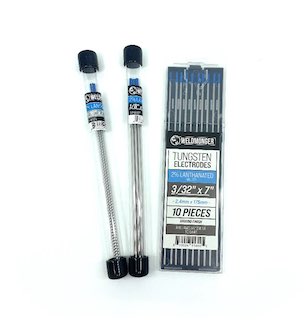
2% lanthanated Tungsten Electrodes...Why I like them ...get yourself some
Tungsten Electrodes...So you just bought a Tig welding machine and you followed my advice on selecting a tig torch...
Now you are going to need an assortment of 1/16, 3/32, and 1/8 tungsten. But before you waste your money on a bunch of different types of electrodes like pure, ceriated, thoriated, lanthanated, zirconiated....to try out, listen to me....
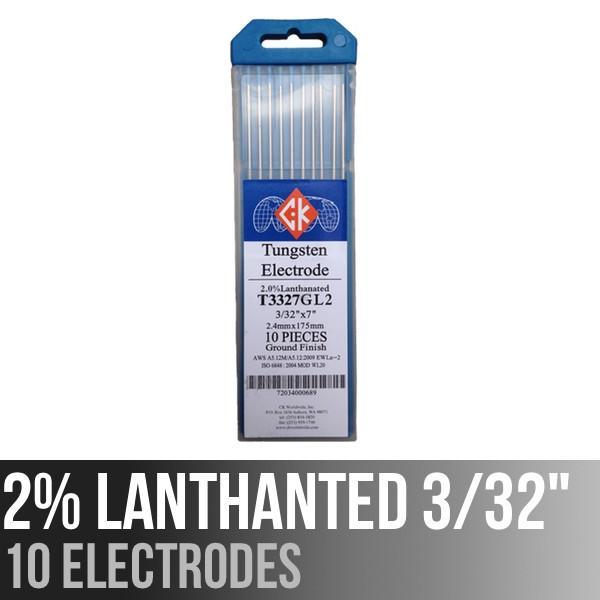
You only really need one type of tungsten in your toolbox
You only need one kind!!
Unless you want to complicate your life, make up your mind to use only one type of tungsten electrode. When you have 2 or 3 different kinds of tungsten in your box and you accidentally grind the color code off, how are you going to know what you have?
Back in the day welders would mainly use either pure tungsten for welding aluminum or 2% thoriated for welding steels.
Even with only 2 different kinds of tungsten, they still got mixed up when the color got ground off.
Even though there has been a lot of talk over the last 10 years or so about thoriated electrodes being hazardous because thorium is slightly radioactive, welders still use them a lot.
Why? because they work.
2% thoriated electrodes have been used more than all the rest...probably because They carry a lot of current, they break easily (something that comes in handy when you get a big blob of metal stuck on the tip) and they can be used on all polarities. (they dont ball good on A/C unless you do it on dcep first).
But...thorium is radioactive.
I personally think thorium is no more harmful that a lot of the other stuff we are exposed to like chromium, manganese, cobalt, ...you get my drift.
But if there is a safer alternative that works just as well, wouldnt that be a good idea?
There is another really good choice now ...Its 2% lanthanated.
I have been using this stuff for several years now and I like it.
2% lanthanated tungsten electrodes handle the amps better than most
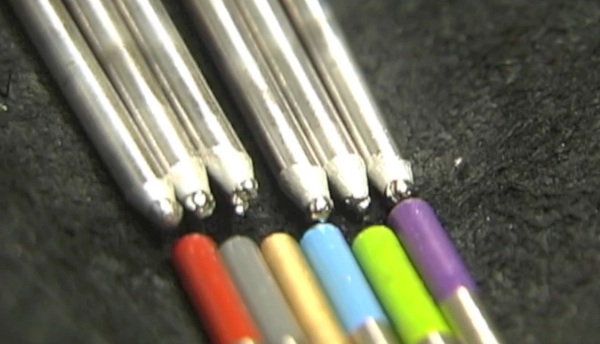
2% lanthanated tungsten handles even more amperage than thoriated and it rounds off better on A/C. If works especially well on inverters like the Miller dynasty 200dx and dynasty 350 where A/C frequencies are typically set to 120 or higher.
It is a great choice to simplify your toolbox and your life.
The only problem with 2% lanthanated is that it does not break cleanly. You cant just snap it with your fingers or 2 pairs of pliers. It bends and splits. You pretty much have to cut it with a grinder or at least score it with a grinder before you break it.
This is a pretty small price to pay for an all purpose tungsten electrode that works on carbon steels, stainless steel, nickel alloys, aluminum, magnesium, titanium, cobalt, copper alloys, pot metal, and everything else.
Back around 2009, I did some testing of different types of tungsten electrodes. I worked for a major airline maintenance department training and certifying welders to do weld repairs on aircraft parts. The only type of electrode stocked in the tool room at that time was 2% thoriated electrodes and that is what we used on everything. Stainless, Nickel alloys, titanium, aluminum, magnesium ...all was welded using 2% thoriated tungsten.
There were a few welders who managed to get some pure tungsten, or zirconiated tungsten for aluminum and magnesium but for the most part , even magnesium gearboxes were welded using 2% thoriated.
But when a safety rep posed the question "are there other alternatives to 2% thoriated that offer good performance with no radiation?" I tested several types to find out.
Without going into a bunch of numbers on low amp arc starts, the results of lots of tests showed me that 2% lanthanated was just as good or better than 2% thoriated. So we switched and it worked out well. Low amp applications like build up on edges of turbine and compressor blades worked fine. And high amperage applications like aluminum gearboxes worked fine too. I never have been a big fan of pure tungsten because it seemed like I often had to use one size large tungsten than I could with 2% thoriated. But 2% lanthanated carries current even better than 2% thor.
Anyway, In this video on this page, I did another test recently with same overall results.
The types of tungsten for this test were:
2% thoriated 2% lanthanated 2% ceriated 1.5 lanthanated layzr trimix E3
All of these types of tungsten electrodes performed well on DCEN. Not much difference using a 10 amp start amperage and 3/32" (2.4mm) diameter electrode
The differences showed up on AC at 200 amps and AC balance set to 65% en.
And that is pretty much the test. I used 200 amps across the board for several seconds to see how the tip of the electrode looked afterwards.
Some did not fare so well.
2% lanthanated kicked butt.
So for an all purpose electrode, whether using a transformer tig welder or an inverter, 2% lanthanated is the best choice in my opinion.
For most folks 2% lanthanated simplifies things by only needing to have one single type of electrode. when you only have one type, you dont have to worry about sharpening both ends and removing the color code.
I wish I could simplify my filler rod collection like that. But I cant.
A lot of folks can get by with 3 or 4 types of filler wire.
I very good start for filler rods to handle most situations would be ER70S-2, ER308L, 4043, ER309, and silicon bronze
I have at least 30 different types of filler rods that I have collected over the years and you need different filler metals to do the type of jobs I have done. Several different aluminum alloys like 4043, 5356, 4047, and pure aluminum several different stainless steel filler rods like 308 , 309, 312, 321, 347, 410 A bunch of nickel alloy rods like hastelloy W, hastelloy X, inconel 82, nichrome V, inconel 625 and 600 a few titanium, magnesium, aluminum bronze, silicon bronze and good ole er70s2
But at least I only need 1 type of electrode.
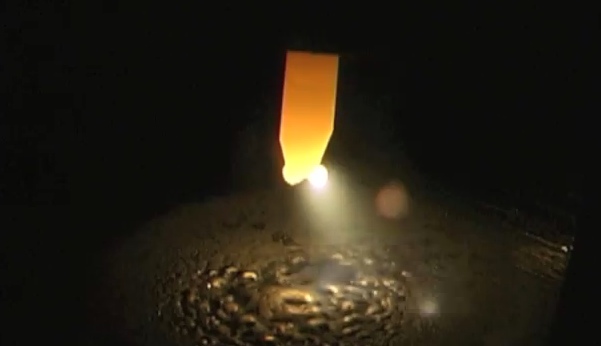
below is a pic of 1.5 lanthanated...2% is way better
you can see a free tungsten electrode guide here at diamondground.com
And while we are on the subject of cutting and sharpening
tungsten electrodes, I posted a page recently with several different
methods for sharpening electrodes and got some interesting
feedback....see the page here...
Tungsten Sharpeners
exit tungsten electrodes and read more tig welding articles
Would you like to get free welding videos in your inbox every week?

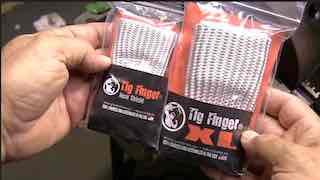
Tig FingersThe Real and Original TIG Finger® and XL model
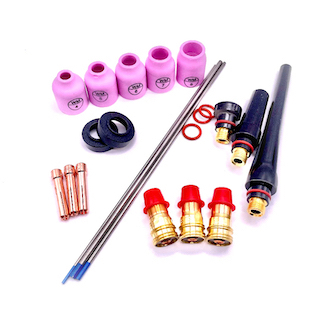
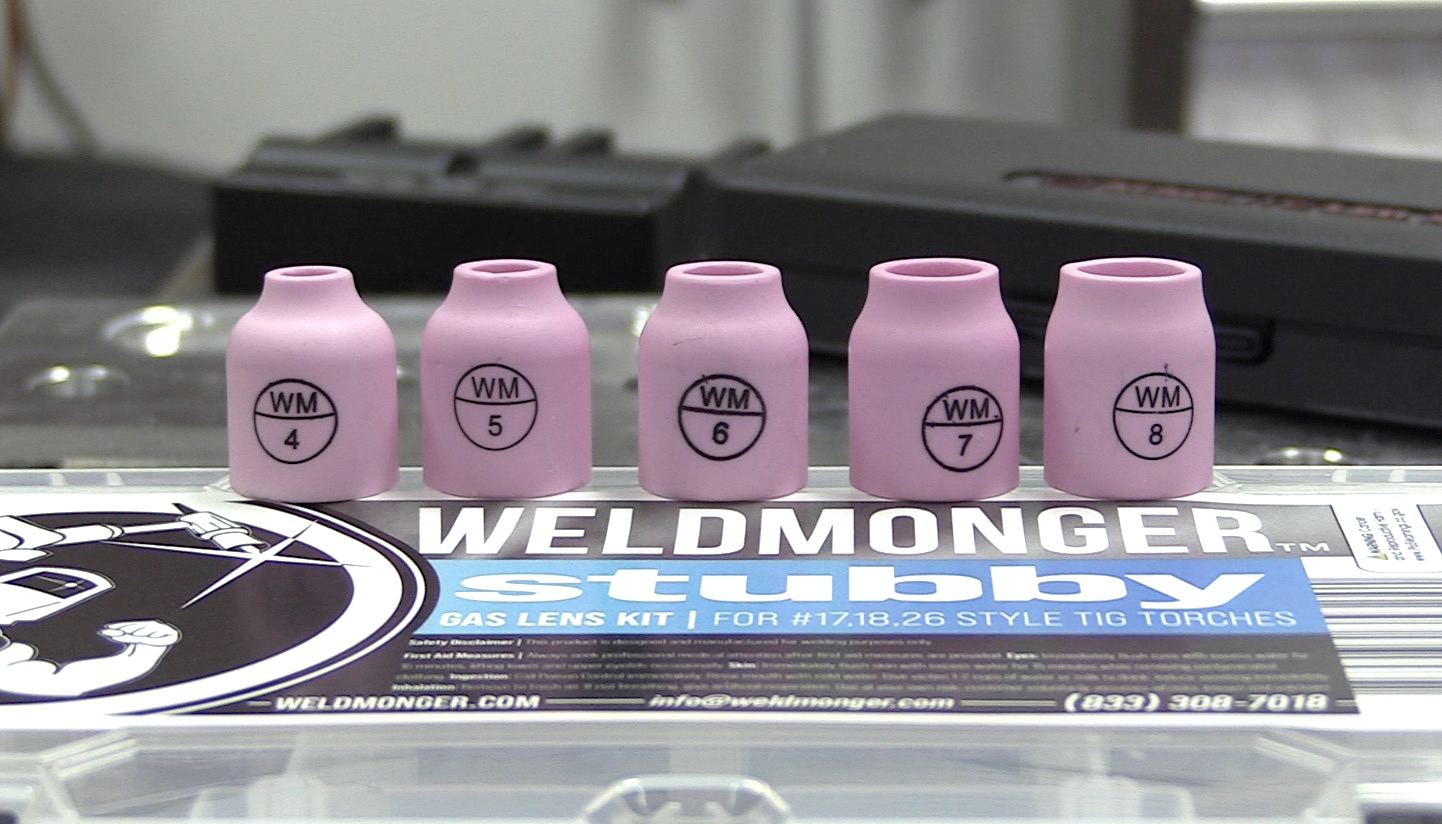
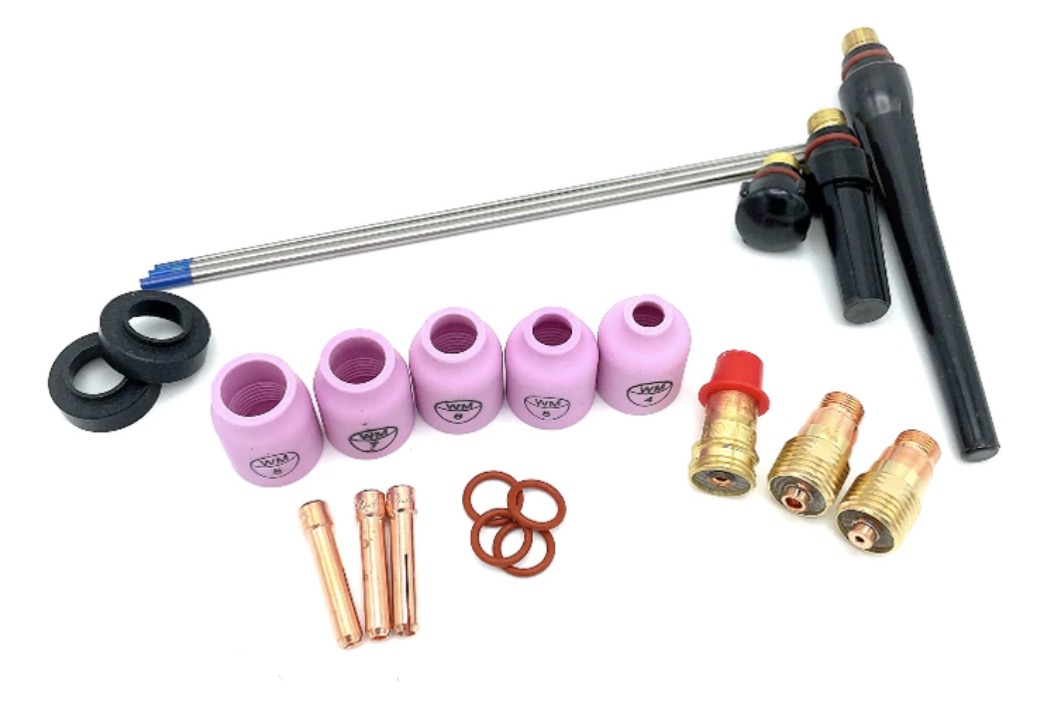
Stubby Gas Lens and Pro TIG kits
2% Lanthanated, CK LaYZr, Purple, more
Our Weldmonger Stubby Gas Lens kit is the Best